Today is Remembrance Sunday here in the UK. To commemorate the day, I thought it would be appropriate to highlight one of my former student’s poetry booklet, War and Remembrance. Written by Gordon Simmonds, I found every poem heartbreaking but breathtaking. I was compelled to read it; these soldiers’ stories are powerfully told. But Gordon doesn’t have the same confidence in his work. He is happy for me to share something that happened to him recently to help other writers who lack belief in themselves:
During a conversation three Saturdays ago, a market trader started quoting Shakespeare at me, and did it well. He’s a hard-boiled ex rock musician and we’ve been friends for years, so it took me by complete surprise (although I knew his bucket list consists of finishing the complete works of Dickens.)
Two weeks ago, I gave him one of the few remaining copies of my poetry booklet, which he promised to read.
Last Saturday, he came up to me, held out his big hoary hand and said, “Gordon; that book ought to be on the reading list of every school in the country!” Which got me thinking.
I’ve never thought it was quite good enough. I’ve never promoted it. I’ve rarely mentioned it among friends, family and colleagues. I’ve never checked the sales figures. I’ve never had a cheque from Kindle. It’s out there, it’s free (I think) – job done!
But then I think back to how my literary peers in the Bahrain Writers Circle enthused over it – but they would, wouldn’t they – they were my friends. Or the editor of the English language newspaper who collected first editions – he kept mine. Another friend who said it should be on sale at the Imperial War Museum. The great Australian songwriter Eric Bogle who wrote some of the most memorable anti-war songs ever written, sat reading with a wee dram in one hand and my book in the other. But perhaps the most poignant of all, should have been the sight of a Chelsea pensioner with tears in his eyes, engrossed in it throughout the pomp and ceremony of the Poppy Ball – perhaps re-living the pain and sacrifice of his own service.
Saturday was a revelation for me. Poetry isn’t about someone’s relationship with the poem, it’s about the relationship between the poem and the reader. My poems mostly tell stories of real people suffering real events in real time. To withhold these stories through some misplaced sense of vulnerability must surely be selfish. The youth of today must be made aware of how the youth of yesterday lived, died and cried.
***
Here is a poem from the booklet:
An Old Soldier’s Thoughts
By
Gordon Simmonds
Don't talk to me of glory when the drums begin to roll,
Just remind me of the shot and shell that takes its deadly toll.
When, standing four square 'gainst the lance,
Each man a frightened pawn of chance,
Who didn't want to be there,
Who didn't want to die.

Don't talk to me of glory when the bugle starts to play,
Just count the cost of mothers sons at the ending of the day.
When, ten thousand men went o'er the top
Through wire and mud they wouldn't stop.
They didn't want to be there,
They didn't want to die.

Don't talk to me of glory when the pipes begin to skirl.
Just see the kilted soldier who would never wed his girl.
Through sea and sand he led the way.
The beach-head made that longest day.
He didn't want to be there,
He didn't want to die.
Yes, talk to me of glory when the battle honours fly,
For each one tells a story of men who didn't want to die.
For some went home and others stayed
In God's green earth their bodies laid.
They didn't want to be there,
They didn't want to die.

So when the Last Post echoes, on some November morn.
Remember those across the years who didn't live to mourn.
Read faceless names engraved in stone
Of those who never made it home.
Though they had to be there,
Did they have to die?

***
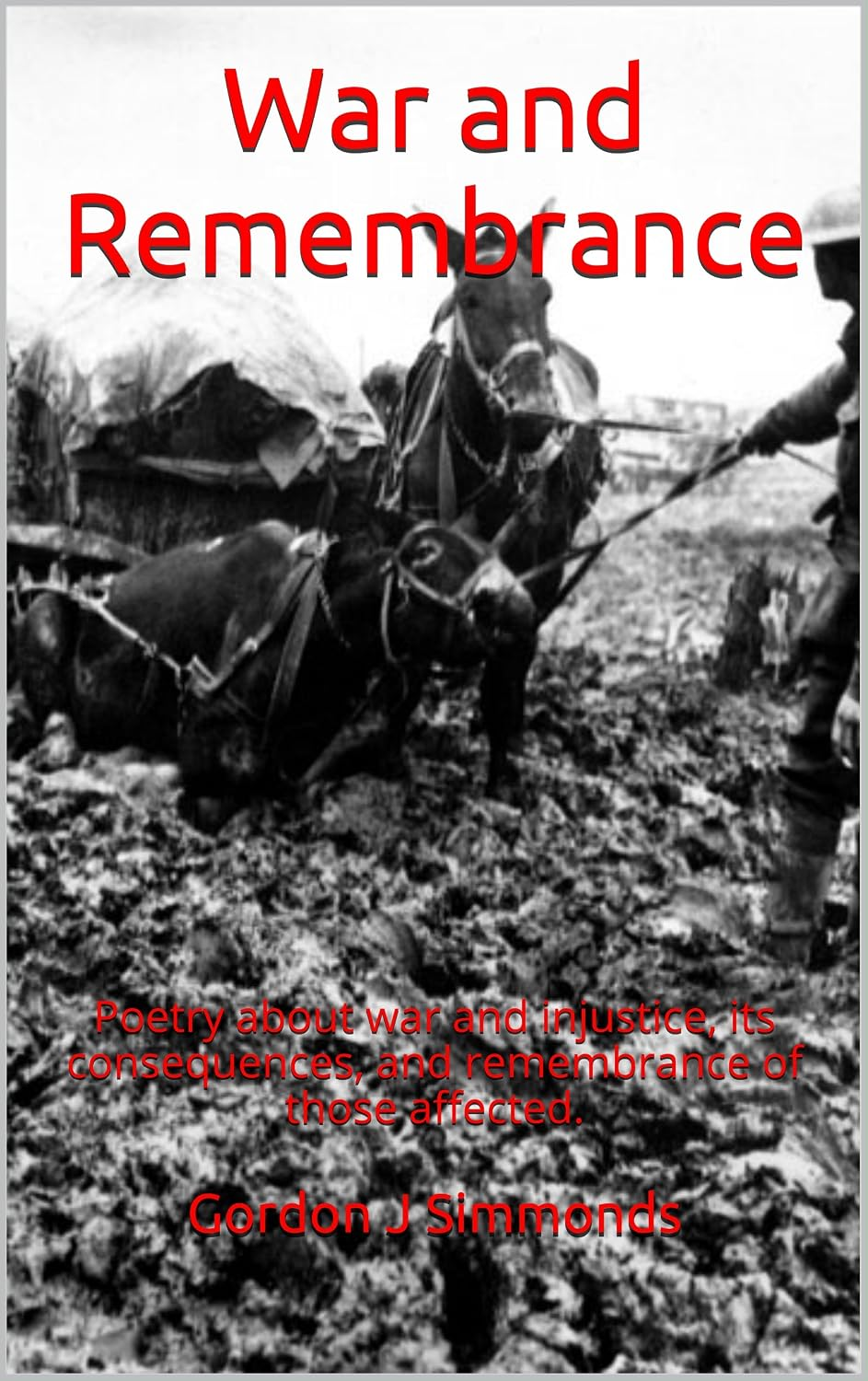
You can find Gordon’s booklet on Amazon. Click here.


Leave a Reply