My guest this week is Robbie Eaton Cheadle. Many of you will be familiar with Robbie’s blog and also her books. Here she gives us an insight into her latest WIP.
Doughnut Girls
By
Robbie Eaton Cheadle
It always surprises me, when I write a novel, how many unexpected bits of historical trivia turn up during my research process.
I am not a ‘pantster’ writer, I must have some direction. I am also not a detailed planner, although I do have a spreadsheet for my planned and partially written Cli-fi trilogy. It is necessary for those books because there are a large number of characters I need to keep a handle on. My standard modus operandus, however, is to write backwards. I plan the ending of my books or stories and then I decide where I’m going to start on the timeline of my story. The timeline is usually historical, except for the unnamed trilogy which is forward looking.
The middle of the book takes its own path as I write towards my planned ending. This path often includes the little pieces of trivia I discover and find interesting, as I think it makes the story more fun and relatable for readers.
One such piece of information I discovered while doing research on America’s participation in World War 1 for my latest WIP, The Soldier and the Radium Girl, is the story of the Doughnut Girls.
The Story of the Doughnut Girls
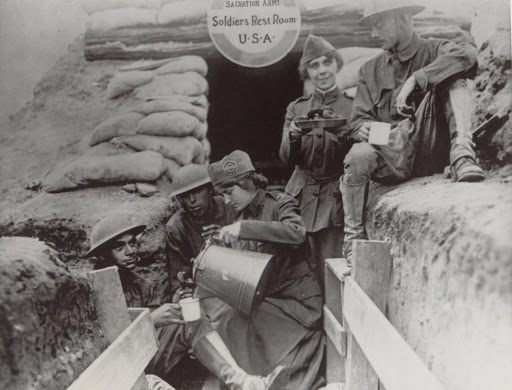
Picture credit:
Americans did not want to enter the war that had erupted in Europe in 1914. President Wilson won his second election campaign with the slogan ‘he kept us out of war.’ As a result, when Wilson delivered his Declaration of War Message to Congress on Germany on the 2nd of April 1917, his voters were not pleased.
The American government had to implement conscription when their recruitment target was not met, and this resulted in an even more negative attitude by the general public towards the war.
The Salvation Army decided to send women to France to lift the spirits of the American soldiers and to serve them comfort food.
When the American troops moved to the front lines in France, morale plummeted to an all-time low following thirty days of straight rain and heavy German gunfire. In an attempt to lift their spirits, Salvation Army Officers, Helen Purviance and Margaret Sheldon, decided to cook the men a treat that would give them ‘a taste of home.’
They managed to beg the necessary eggs from the residents of a nearby village and raid ration packs for sugar to make doughnuts. They also had to invent new methods of shaping the dough by using ammunition shells as rolling pins and tin cans as cutters. The first doughnuts were fried, seven at a time, in a pan.
When these overcooked doughnuts were served, they were a huge hit with the homesick soldiers and before long the women of the Salvation Army, nicknamed the Doughnut Lassies, were serving up to 9,000 doughnuts a day. The doughnut became a symbol of everything the Salvation Army was doing to ease the hard lives of the fighting men at the front. The ‘Doughnut Lassies’ were featured in newspaper headlines and recruitment posters across the United States.
When World War 1 ended and the troops returned home, the demand for doughnuts continued.
–
Roberta Eaton Cheadle is a South African writer and poet specialising in historical, paranormal, and horror novels and short stories. She is an avid reader in these genres and her writing has been influenced by famous authors including Bram Stoker, Edgar Allan Poe, Amor Towles, Stephen Crane, Enrich Maria Remarque, George Orwell, Stephen King, and Colleen McCullough.
Roberta has short stories and poems in several anthologies and has two published novels, Through the Nethergate, a historical supernatural fantasy, and A Ghost and His Gold, a historical paranormal novel set in South Africa.
Roberta has nine children’s books published under the name Robbie Cheadle.
Roberta was educated at the University of South Africa where she achieved a Bachelor of Accounting Science in 1996 and a Honours Bachelor of Accounting Science in 1997. She was admitted as a member of The South African Institute of Chartered Accountants in 2000.
Roberta has worked in corporate finance from 2001 until the present date and has written seven publications relating to investing in Africa. She has won several awards over her 20-year career in the category of Transactional Support Services.


 Esther Chilton
Leave a reply to memadtwo Cancel reply