Guest Writer Spot – @RobertaEaton17

My guest this week is Robbie Eaton Cheadle. Many of you will be familiar with Robbie’s blog and also her books. Here she gives us an insight into her latest WIP.

Doughnut Girls

By

Robbie Eaton Cheadle

It always surprises me, when I write a novel, how many unexpected bits of historical trivia turn up during my research process.

I am not a ‘pantster’ writer, I must have some direction. I am also not a detailed planner, although I do have a spreadsheet for my planned and partially written Cli-fi trilogy. It is necessary for those books because there are a large number of characters I need to keep a handle on. My standard modus operandus, however, is to write backwards. I plan the ending of my books or stories and then I decide where I’m going to start on the timeline of my story. The timeline is usually historical, except for the unnamed trilogy which is forward looking.

The middle of the book takes its own path as I write towards my planned ending. This path often includes the little pieces of trivia I discover and find interesting, as I think it makes the story more fun and relatable for readers.

One such piece of information I discovered while doing research on America’s participation in World War 1 for my latest WIP, The Soldier and the Radium Girl, is the story of the Doughnut Girls.

The Story of the Doughnut Girls
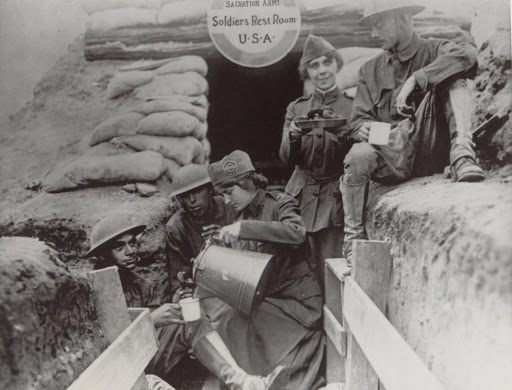
Picture credit:

https://www.worldwar1centennial.org/index.php/communicate/press-media/wwi-centennial-news/3929-doughnut-girls-the-women-who-fried-donuts-and-dodged-bombs-on-the-front-lines-of-world-war-i.html

Americans did not want to enter the war that had erupted in Europe in 1914. President Wilson won his second election campaign with the slogan ‘he kept us out of war.’ As a result, when Wilson delivered his Declaration of War Message to Congress on Germany on the 2nd of April 1917, his voters were not pleased.

The American government had to implement conscription when their recruitment target was not met, and this resulted in an even more negative attitude by the general public towards the war.

The Salvation Army decided to send women to France to lift the spirits of the American soldiers and to serve them comfort food.

When the American troops moved to the front lines in France, morale plummeted to an all-time low following thirty days of straight rain and heavy German gunfire. In an attempt to lift their spirits, Salvation Army Officers, Helen Purviance and Margaret Sheldon, decided to cook the men a treat that would give them ‘a taste of home.’

They managed to beg the necessary eggs from the residents of a nearby village and raid ration packs for sugar to make doughnuts. They also had to invent new methods of shaping the dough by using ammunition shells as rolling pins and tin cans as cutters.  The first doughnuts were fried, seven at a time, in a pan.

When these overcooked doughnuts were served, they were a huge hit with the homesick soldiers and before long the women of the Salvation Army, nicknamed the Doughnut Lassies, were serving up to 9,000 doughnuts a day. The doughnut became a symbol of everything the Salvation Army was doing to ease the hard lives of the fighting men at the front. The ‘Doughnut Lassies’ were featured in newspaper headlines and recruitment posters across the United States.

When World War 1 ended and the troops returned home, the demand for doughnuts continued.

Roberta Eaton Cheadle is a South African writer and poet specialising in historical, paranormal, and horror novels and short stories. She is an avid reader in these genres and her writing has been influenced by famous authors including Bram Stoker, Edgar Allan Poe, Amor Towles, Stephen Crane, Enrich Maria Remarque, George Orwell, Stephen King, and Colleen McCullough.

Roberta has short stories and poems in several anthologies and has two published novels, Through the Nethergate, a historical supernatural fantasy, and A Ghost and His Gold, a historical paranormal novel set in South Africa.

Roberta has nine children’s books published under the name Robbie Cheadle.

Roberta was educated at the University of South Africa where she achieved a Bachelor of Accounting Science in 1996 and a Honours Bachelor of Accounting Science in 1997. She was admitted as a member of The South African Institute of Chartered Accountants in 2000.

Roberta has worked in corporate finance from 2001 until the present date and has written seven publications relating to investing in Africa. She has won several awards over her 20-year career in the category of Transactional Support Services.


79 responses to “Guest Writer Spot – @RobertaEaton17”

  1. Robbie is such a versatile writer and her research is incredible. This was a great bit of history I knew nothing about. Thanks for this great post, Esther.

    Liked by 1 person

    1. Thank you, Darlene. I am really getting into this WIP now and hope to get a lot done over my Christmas holiday.

      Liked by 1 person

      1. Good luck!! Feels good to be on a writing streak, doesn’t it.

        Like

      2. Yes, I struggle for time, the last two years more than ever as covid seems to have made everything more difficult. I am looking forward to have three weeks of mornings to just write.

        Like

    2. I agree, Darlene. I found it really interesting, too.

      Like

  2. I just LOVE this story of doughnut girls! They used to be my favorite treat when I was a youngster because we go them so infrequently.

    Liked by 1 person

    1. I loved this story too, Annette. I had no idea doughnuts became so popular as a result of WW1. We also don’t have them often but they are a lovely treat.

      Liked by 1 person

    2. It’s a great story, isn’t it? 😊

      Like

  3. Interesting facts – thanks Robbie. I had never heard of the ‘Doughnut Girls’. A nice treat for the soldiers.

    Liked by 1 person

    1. Hi Stevie, I also thought this was very interesting. Who knew that doughnuts had such an interesting beginning.

      Liked by 2 people

      1. Lol, they’re too sweet for me, but millions like them.

        Like

  4. What a lovely true wartime tale. Thanks Robbie and Esther for hosting really enjoyed. x

    Liked by 1 person

    1. HI Marje, I am delighted this post piqued your interest. I am finding the US version of events during WW1 very intriguing.

      Liked by 1 person

      1. Yes, must make for fascinating research Robbie. x

        Liked by 1 person

    2. It was great, wasn’t it? Thanks, Marje. Hope your writing is going well x

      Like

      1. Hi Esther not finding much time for writing as in process of moving abroad, hoping eventually to get residency in Portugal. Complicated by brexit and covid!

        Liked by 1 person

      2. It can’t be easy. Good luck!

        Like

  5. Reblogged this on and commented:
    I am over at Esther Chilton’s blog with a post about the Doughnut Girls from World War 1 who feature in my latest WIP, The Soldier and the Radium Girl. Thank you to Esther for hosting me. Esther has a fabulous book for writers called Publication Guaranteed. You will find a link for it on her blog.

    Liked by 1 person

  6. HI Esther, thank you for hosting me today. Have a lovely weekend.

    Liked by 1 person

    1. It was an absolute pleasure. It made a great read 😊

      Liked by 1 person

  7. Great, well-described historical find about donuts during “The Great War,” Robbie! I had no idea! If only there were more donuts and fewer military weapons… 😦

    Liked by 1 person

    1. Hi Dave, I am glad you enjoyed this post. The Donut girls were an interesting part of US WW1 history. I had no idea that is how donuts started.

      Like

  8. That’s fascinating stuff – nice one, Robbie! I’d never heard of the doughnut girls of WW1 – lovely story! But my mum did used to talk about ‘the doughnut dugout’, which was some kind of snack thing US troops set up in her home town during the latter part of WW2. Doughnuts – and foreign troops, of course – were a touch of glamour in drab wartime Britain. I think my dad, who was overseas at the time, was less impressed.

    Liked by 2 people

    1. HI Mike, my mom never mentioned the US troops having doughnuts. Her family lived in Nethergate Street Bungay and there were US troops stationed at Flixton and on Bungay common. She has mentioned they had chewing gum and the kids used to pester the soldiers to give them some. WW2 certainly was hard times for people.

      Liked by 1 person

  9. What an awesome piece of historical trivia! It’s amazing how important a small piece of comfort can be. Everything I’ve read about the trenches makes them sound like a slice of hell on earth, so it’s terrific that the “Doughnut Lassies” found a way to bring some happiness into a horrible time. Thanks for sharing this. : )

    Liked by 1 person

    1. Thank you for your comment. I’m glad you enjoyed it 😊

      Like

    2. Hi Cathleen, I am glad you enjoyed this post. I think these ladies were marvelous to go to the front lines and set up kitchens for the soldiers. Some of the ladies also helped by doing washing for the troops. Very admirable. I sometimes wonder what would happen if there was a war now.

      Like

  10. I didn’t know this, Robbie. What a great addition to my WWI knowledge.

    Liked by 1 person

    1. Hi Jacqui, I am delighted I could share something new to you.

      Like

  11. cool info Robbie; I wonder when they stuck jam inside for the first time?

    Liked by 1 person

  12. The stuff you find when researching books! Side-tracked…down rabbit warrens…but it all comes in useful!

    Liked by 1 person

    1. Thanks for your comment, Mick.

      Liked by 1 person

    2. HI Mick, you are quite right, history is so extensive and there is so much to discover when you do research. This is why the middle of my books are loosely planned, so that I can build this sort of detail into the story.

      Liked by 1 person

      1. Do you ever find that what you uncover forces your books off in a totally different direction, Robbie?

        Liked by 1 person

      2. Hi Mick, not in a totally different direction. My ending and storyline is already there so the information I discover usually gets woven into the middle part which I leave quite loose in my structure. I am not a pantster.

        Liked by 1 person

      3. Ah, and more strong-willed than me. I sometimes find something that practically forces me to change direction.

        Liked by 1 person

      4. There is nothing wrong with that, Mick. We all have our own styles. I am a chartered accountant so planning is deeply ingrained in me [grin].

        Liked by 1 person

      5. Ha, yes! I should be good at it too, but it all falls down when I write.

        Liked by 1 person

  13. Bette A. Stevens Avatar
    Bette A. Stevens

    Great research facts, Robbie! Know you’ll weave them into a fascinating historical fiction novel. ❤

    Liked by 1 person

    1. HI Bette, I am so pleased you enjoyed this post.

      Like

  14. I’d forgotten that tidbit about the origin of the term “doughboy” for WWI soldiers! I read the article you linked. I was struck by imagining how excited that first group of soldiers to smell doughnuts frying at the front must have been.

    Liked by 1 person

    1. Thank you for your comment 😊

      Liked by 1 person

    2. Hi Liz, I have been reading up about the ‘doughboys’ introduction to the Western Front. Such a terrible experience for all the young men. This certainly brought a bit of home and caring to them and was a very honourable and courageous thing for these young women to do.

      Liked by 1 person

      1. Hi, Robbie. I did wonder whether the doughnut girls experienced the worst of life in the trenches with the men–or were they further back?

        Liked by 1 person

      2. Hi Liz, they were further back. They way I understand it, there were three layers of troops, the front line, the support (the intermediate layer which gave support to the front line if required and spent a lot of time digging trenches) and the reserve which was further back. The soldiers had proper billets in the reserve compound, bathing houses, and its where the hospitals were. That is where these ladies would have been most of the time.

        Liked by 1 person

      3. Thank you! That makes sense. (I figured you would have found those details.)

        Liked by 1 person

  15. Great interview! You can never underestimate the power of comfort food.

    Liked by 1 person

    1. Glad you enjoyed it 😊

      Like

    2. Thank you, Julie, it has long been said that the way to a man’s heart is through his stomach. Good food definitely makes you feel better.

      Like

    1. Thank you for your comment.

      Like

  16. Hi Esther and Robbie – thanks for sharing this about the Doughnut Girls. I had not heard this story before. We have so much more written about WW2 than WW1. It’s good to see this.

    Liked by 1 person

    1. HI Barbara, I am so pleased I could share something new with you. I am very deeply involved with WW1 right now. It was such a dreadful, yet fascinating, war.

      Like

      1. I think I already know this, but have you read All Quiet on the Western Front? Such an excellent book.

        Liked by 1 person

      2. Yes, I read that one this year as well. A very good book. I also want to re-read some books like A Journal of the Plague Year and The Scarlet Letter but its hard to find the time when there are so many I haven’t as yet read.

        Liked by 1 person

      3. I thought so. Oh The Scarlett Letter – we had to read that in school – I’m pretty sure I had to read it another time for a class. I don’t know the other book, A Journal of the Plague Year. It’s hard to fit books in – there are also so many I want to read.

        Liked by 1 person

      4. A Journal of the Plague Year is by Daniel Defoe. It is about the great plague of London and is fascinating, especially given our current pandemic. So many books and so little time.

        Liked by 1 person

      5. Interesting. I read The Ghost Map by Steven Johnson which is about the the cholera epidemic in London in 1854. You’re right about so little time!

        Liked by 1 person

      6. I didn’t know about that book. Another for my long list!

        Liked by 1 person

      7. Mine is miles long!

        Liked by 1 person

    2. I’m so glad you enjoyed it. It’s a fascinating story.

      Liked by 1 person

  17. I always learn something from your writing Robbie. So much that the history books leave out! It would make the study of history much more interesting to include them. (K)

    Liked by 1 person

    1. Many thanks for the comment.

      Liked by 1 person

    2. Hi Kerfe, thank you for visiting me here. I am glad you enjoyed this piece about the Doughnut Lassies. I agree that non-fiction historical books leave out a lot of the human interest aspects of an event.

      Liked by 1 person

  18. What a fascinating tidbit of history, Robbie. I can imagine the comfort that came from doughnuts, and 9,000 a day is huge! Thanks for hosting, Esther.

    Liked by 1 person

    1. Many thanks for your comment. It is a fascinating piece.

      Liked by 1 person

    2. HI Diana, I am glad you enjoyed this little bit of history, Diana. I imagine there are a lot of doughnuts consumed daily in the USA and the larger world. I have never been able to eat doughnuts as I have yellow jaundice as a young girl and it damaged my liver. I can’t eat fatty foods.

      Liked by 1 person

      1. And doughnuts are rather fatty. Good for you for taking care of yourself and watching what you eat. I don’t eat doughnuts either, but because of the sugar!

        Liked by 1 person

      2. Sometime the choice is just removed by adverse physical reactions to foods [smile].

        Liked by 1 person

  19. gotta love the Salvation Army. and who doesn’t like doughnuts?

    and my guess is that your spreadsheet is probably nicer than most authors 🙂

    good luck with your book…

    Liked by 1 person

    1. Hi Jim, this was a massive mobilisation exercise by the Salvation Army, they send the Doughnut girls and also the nurses and other caregivers for the hospitals. They even provided washing services for the men. Pretty impressive how the nation came together to fight this war.

      Liked by 1 person

      1. nothing brings people together like a common enemy…

        Liked by 1 person

  20. The story of the doughnut girls as revealed by Robbie’s research is very interesting. The story brings another organisation to mind who were always a welcome sight when we came off Army ranges, cold and wet: the WRVS van. The Women’s Royal Voluntary Service do so much more than serve up hot drinks and food to needy soldiers. Over their history, they have made vital contributions during hard times, including feeding and clothing evacuees from Dunkirk in WWII when they returned to England’s shores.
    What interested me most in this guest spot though, is Robbie’s MO: neither a planner nor a panster. I fell into this MO, unintentionally, during the writing of my first novel. I had written about one-third of the manuscript, when I awoke in the middle of the night with the final chapter in my mind. I got up and wrote it. I then had something to aim for as I wrote the middle of the book. When I finally arrived at that last chapter, I expected that I’d have to re-write it. I changed three words.
    It’s an effective MO.

    Liked by 1 person

    1. Very interesting, Lance.

      Liked by 1 person

  21. A fascinating piece of history and obviously needing a great deal of research first. Thanks, Robbie, really enjoyed this. x

    Liked by 1 person

    1. It’s a great post by Robbie, isn’t it? Very interesting.

      Liked by 1 person

      1. She always posts really great articles, reviews and is so supportive of not just me, but other authors. A gem! xx

        Liked by 1 person

Leave a reply to Chris Hall Cancel reply

Discover more from Esther Chilton

Subscribe now to keep reading and get access to the full archive.

Continue reading