A Plumb Job
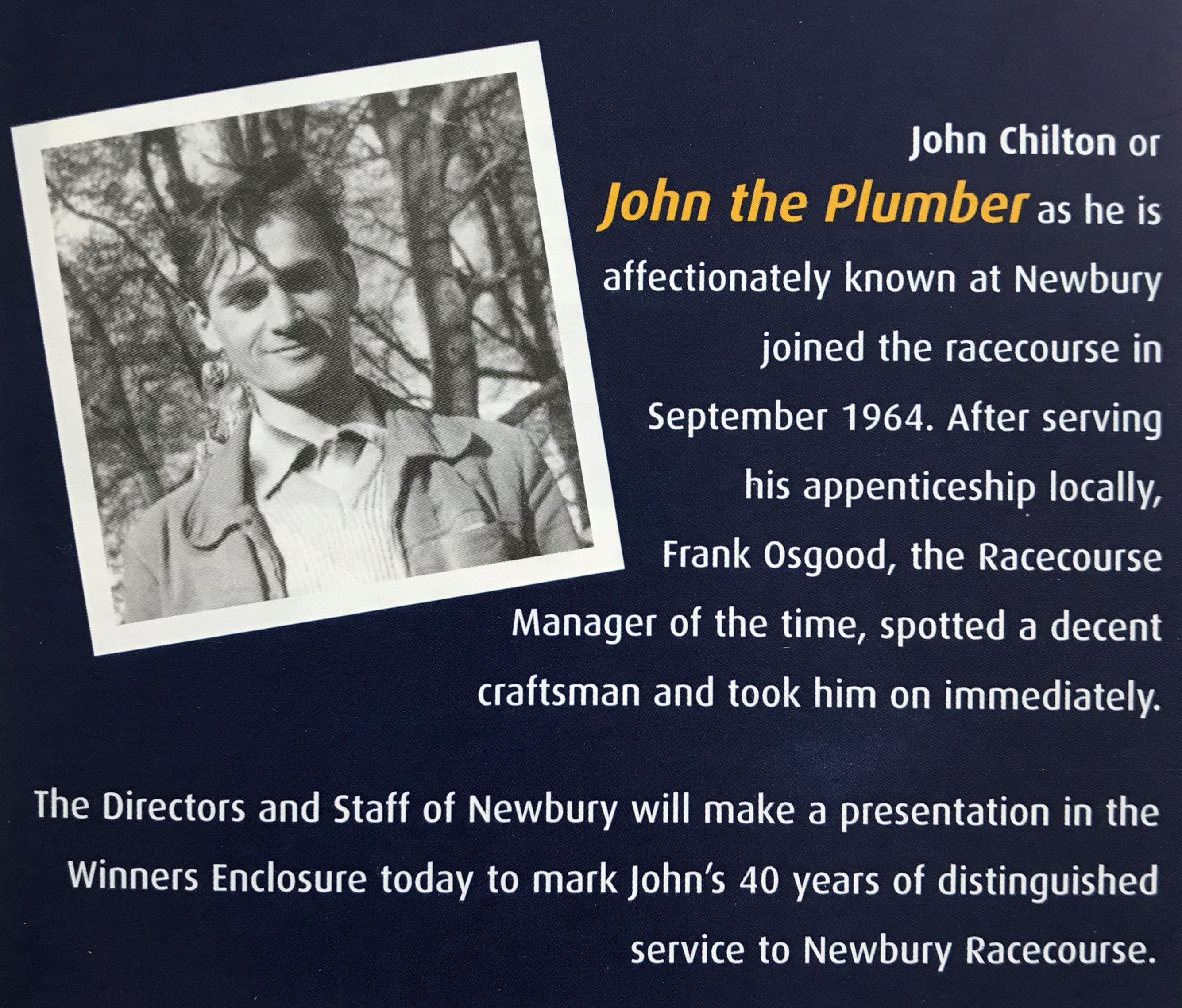
Growing up in Newbury, Berkshire, with a racecourse on my doorstep, many would think it was inevitable that I spent some time there. I did, though many of my friends haven’t ever set foot on the course. But their father wasn’t the racecourse plumber for forty-four years. As mine was, it meant I spent many a day of my childhood in the ‘cloakroom’ (a tiny room where he ate his sandwiches) with Dad, as well as walking around the course, watching the horses and obtaining autographs from celebrity race goers and jockeys on race days.

The racecourse opened in 1905, but it may not have come about if it wasn’t for John Porter, a trainer from nearby Kingsclere. He thought Newbury would make an ideal location for a racecourse because it was easily accessible from every direction. Nonetheless, he faced opposition from The Jockey Club who believed the country didn’t need another racecourse. John wasn’t going to give up easily and managed to get King Edward VII’s support after a chance encounter, resulting in the granting of a licence.
Work on the racecourse started in 1904 after The Newbury Racecourse Company was formed. The land was bought and the building work and course construction began. The cost? At the time, a mere £57,240.
The first meeting took place over two days, on Tuesday 26th and Wednesday 27th September 1905. It’s estimated that 15,000 racegoers attended the first day and half that the second day. A members’ badge which covered the two days was priced at seven guineas. In the first race, the five-furlong Whatcombe Handicap, worth £160, 28 horses went to post, with Copper King the winner.
Newbury saw its first royal visitor in 1907, at the July meeting, when the King accepted a lunch invitation from Lord Carnarvon; they dined in the Royal Box. It was reported in the accounts that “His Majesty the King patronised the July Summer Meeting for the first time and expressed to the Managing Director his complete approval.”
Despite a series of fires breaking out in 1908, due to sparks from railway engines on the nearby rail track (Great Western Railway was fined £10), the racecourse and racing went from strength to strength, with more race days added to the racing calendar until war broke out in 1914, when the racecourse was taken over by The War Office. They took compulsory possession of the stables, stands and other areas of the premises for the purpose of a troops camp and prisoner of war camp. In April 1916, the War Office ceased occupation, but the Ministry of Munitions took over, utilising the racecourse as an inspection depot and tank repair park. Limited racing took place until 1919.
The racecourse once again found itself requisitioned for use by troops and as a prisoner of war camp in the Second World War (some years later, when renovation work took place on the stables, stunning artwork by Karl Schultz, a prisoner of war, was uncovered. Karl has since returned to Newbury to see his pictures). Racing was sporadic during this period, especially after enemy aircraft dropped bombs on part of the course in May 1941. But the craters were quickly filled in and new turf laid; after the Jockey Club Inspector approved the course, racing recommenced. It didn’t last for long and in 1942, the whole area was handed over to the American Army. The General Manager, John E Osgood, sat in his office, the only part of the weighing room and racecourse that hadn’t been taken over, and watched as the racecourse changed beyond all recognition as the Americans used it as a vast depot and marshalling yard, named G45. Thirty-seven miles of railway track were laid, as well as roads. Supplies were sent to Europe and further afield in North Africa for the invasions.
Even when de-requisitioning of the racecourse started in 1947, it took over two years before the course was restored and racing could restart. The priority was the reinstatement and preparation of the course, but the stands, stables and other buildings also needed refurbishment.
Newbury Racecourse saw itself used as a base once more, this time by the police during the Greenham Common Protests in the 1980s and during protests against the Newbury by-pass in the 1990s. Though, only part of the course was used and racing continued as usual.
Newbury racing has been televised for many years since the BBC and British Paramount News were given permission to broadcast racing in 1949. But it isn’t only the racing that’s been filmed there. My father remembers Cilla Black appearing at the racecourse during the filming of an episode of her TV show, ‘Surprise Surprise’. He also recalls Sir Terry Wogan being filmed there as well as parts of the TV series, ‘Trainer’, about a fictious trainer striving to make his name in the horse racing world. It starred David McCallum and Susannah York.
Aside from filming, Newbury Racecourse has seen many a film star on race days over the years, from Jean Simmonds to Elizabeth Taylor. It’s a racecourse that has also been frequented by the royals, with the Queen Mother frequently seen at Newbury. My father remembers being asked to open the gates for her, when she arrived in a car one race meeting. She was very appreciative and called out, “Thank you, good man,” as she passed by.
The Queen also enjoys racing at Newbury. She even spent her 86th birthday at Newbury Races, watching the racing, including her own horse, which sadly, didn’t win. In 1990, an anonymous bidder paid the sum of £10,900 for five green leather armchairs used by the Queen, Prince Philip and other royals when they watched the racing at Newbury. The auctioneers had thought they’d only fetch around £1000.
The Queen holds a garden party every year and invites “a broad range of people from all walks of life, all of whom have made a positive impact in their community.” In 2002, she invited the two longest serving members on the Newbury Racecourse staff to her garden party at Buckingham Palace. One of them was my father. He still has the invitation and envelope postmarked ‘Buckingham Palace’. He recalls thinking it was a hoax at first. Both he and my mother attended the party and it’s a day they’ll always remember.

The Newbury Racecourse of today is very different to the one John Porter first envisioned over a hundred years ago. It still has a full racing calendar, both flat racing and national hunt, but if you visit the course, you’ll see houses and flats in front and alongside the course, as well as The Lodge hotel and the Rocking Horse nursery, for young children. Weddings and conferences regularly take place there and concerts on set race days, with Tom Jones and Madness recent performers. Classic car shows, dolls house exhibitions and antiques fairs are just some of the events which have taken place at the course over the years. I wonder what John Porter would make of it.


 Esther Chilton
Leave a reply to Ritu Cancel reply